[1] Wu C., Wang S.S., Li J., Exergoeconomic analysis and optimization of a combined supercritical carbon dioxide recompression Brayton/organic flash cycle for nuclear power plants. Energy Conversion and Management, 2018, 171: 936–952.
[2] Du Y., Yang C., Hu C., et al., Thermodynamic design and off-design investigation of nuclear power supercritical CO2 recompression cycle. Nuclear Engineering and Design, 2020, 369: 110851.
[3] Reinsch T., Dobson P., Asanuma H., et al., Utilizing supercritical geothermal systems: a review of past ventures and ongoing research activities. Geothermal Energy, 2017, 5(1): 16.
[4] Jia L., Chen H., Xu Y., et al., A solar energy storage and power generation system based on supercritical carbon dioxide. Renewable Energy, 2014, 64: 43–51.
[5] Sharma O.P., Kaushik S.C., Manjunath K., Thermodynamic analysis and optimization of a supercritical CO2 regenerative recompression Brayton cycle coupled with a marine gas turbine for shipboard waste heat recovery. Thermal Science & Engineering Progress, 2017: 62–74.
[6] Xia L., Li X.S., Song J., Ren X.D., et al., Design and analysis of S-CO2 cycle and radial turbine for SOFC vehicle waste-heat recovery. Journal of Thermal Science, 2019, 28(3): 559–570.
[7] Crespi F., Gavagnin G., Sánchez D., et al., Supercritical carbon dioxide cycles for power generation: A review. Applied Energy, 2017, 195: 152–183.
[8] Hines W.S., Wolf H., et al., Pressure oscillations associated with heat transfer to hydrocarbon fluids at supercritical pressures and temperatures. ARS Journal, 1962, 32(3): 361–366.
[9] Linne D.L., Meyer M.L., Edwards T., et al., Evaluation of heat transfer and thermal stability of supercritical JP-7 fuel. American Institute of Aeronautics and Astronautics 33rd Joint Propulsion Conference and Exhibit, 1997, paper No. 98-0784-M.
[10] Liu Z., Bi Q., Guo Y., et al., Convective heat transfer and pressure drop characteristics of near-critical-pressure hydrocarbon fuel in a minichannel. Applied Thermal Engineering, 2013, 51(1–2): 1047–1054.
[11] Yang Z.Q., Bi Q.C., Liu Z.H., et al., Heat transfer to supercritical pressure hydrocarbons flowing in a horizontal short tube. Experimental Thermal & Fluid Science, 2015, 61: 144–152.
[12] Zhang L., Wang H., Gu H., et al., Experimental investigations on flow instabilities in a forced circulation loop at near-critical and supercritical pressures. American Institute of Physics, 2013, 1547: 312–319.
[13] Xiong T., Xiao Y., Xiao Z., et al., Experimental study on flow instability in parallel channels with supercritical water. Annals of Nuclear Energy, 2012, 48: 60–67.
[14] Wang W., Yang D., Liang Z., et al., Experimental investigation on flow instabilities of ultra-supercritical water in parallel channels. Applied Thermal Engineering, 2019, 147: 819–828.
[15] Sharabi M.B., Ambrosini W., He S., Prediction of unstable behavior in a heated channel with water at supercritical pressure by CFD models. Annals of Nuclear Energy, 2008, 35(5): 767–782.
[16] Su Y., Jian F., Hao Z., et al., Theoretical study on the flow instability of supercritical water in the parallel channels. Progress in Nuclear Energy, 2013, 68: 169–176.
[17] Adelt M., Mikielewicz J., Heat transfer in a channel at supercritical pressure. International Journal of Heat and Mass Transfer, 1981, 24(10): 1667–1674.
[18] Sharma M., Pilkhwal D.S., Asako Y., Steady state and stability characteristics of natural circulation loops operating with carbon dioxide at supercritical pressures for open and closed loop boundary conditions. Nuclear Engineering and Design, 2013, 265: 737–754.
[19] Liu G., Huang Y., Wang J., et al., Experimental research and theoretical analysis of flow instability in supercritical carbon dioxide natural circulation loop. Applied Energy, 2017, 205: 813–821.
[20] Cai D.N., Xu X.X., Zhang S.J., et al., Experimental investigation on the flow instability of supercritical CO2 in vertical upward circular tube in trans-critical CO2 Rankine system. Applied Thermal Engineering, 2020, 183: 116139.
[21] Singh I., Chatoorgoon V., Experiments and analyses of supercritical CO2 flow instability with study of wall heat-storage and dimensionless parameters. Applied Thermal Engineering, 2020, 186(8): 116378.
[22] Jain P.K., Rizwan-uddin, Numerical analysis of supercritical flow instabilities in a natural circulation loop. Nuclear Engineering and Design, 2008, 238(8): 1947–1957.
[23] Lin C., Zhang X.R., Yamaguchi H., et al., Effect of heat transfer on the instabilities and transitions of supercritical CO2 flow in a natural circulation loop. International Journal of Heat and Mass Transfer, 2010, 53(19–20): 4101–4111.
[24] Chatoorgoon V., Supercritical flow stability in horizontal channels. Nuclear Engineering & Design, 2008, 238(8): 1940–1946.
[25] Ampomah-Amoako E., Akaho E., Nyarko B., et al., Analysis of flow stability in nuclear reactor subchannels with water at supercritical pressures. Annals of Nuclear Energy, 2013, 60: 396–405.
[26] Ampomah-Amoako E., Ambrosini W., Developing a CFD methodology for the analysis of flow stability in heated channels with fluids at supercritical pressures. Annals of Nuclear Energy, 2013, 54(54): 251–262.
[27] Ambrosini W., Sharabi M., Dimensionless parameters in stability analysis of heated channels with fluids at supercritical pressures. Nuclear Engineering and Design, 2008, 238(8): 1917–1929.
[28] Sharabi M., Ambrosini W., He S., et al., Transient three-dimensional stability analysis of supercritical water reactor rod bundle subchannels by a Computatonal Fluid Dynamics code. Journal of Engineering for Gas Turbines and Power, 2009, 131(2): 022903.

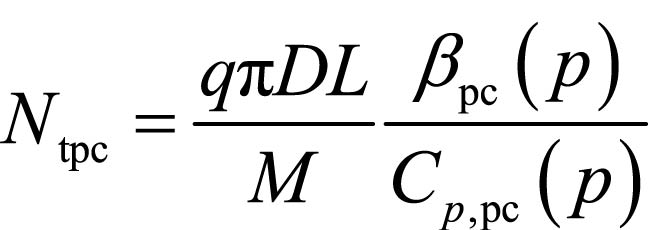 (trans-pseudocritical number) is introduced. The critical trans-pseudocritical number Ntpc,c first goes up and down with the increase of the inlet pressure and the reduction of the inlet temperature. The rise of the mass flow rate, the shortening of the tube length, and the enlargement of the tube diameter all induce the temperature difference along the radial direction to become large. These tendencies make the critical Ntpc,c small. Consequently, the stability boundary
  is obtained to distinguish the regions of the flow and heat transfer stability and instability.
