Influence Rules of Intensity and Circumferential Position of Induced Shock Wave on the Tip Flow Behaviors of a Transonic Rotor

  • CUI Weiwei ,
  • ZHANG Long ,
  • ZHAO Qingjun ,
  • CHEN Xinyuan ,
  • CHANG Guozhang ,
  • WANG Cuiping
Expand
  • 1. College of Energy Storage Technology, Shandong University of Science and Technology, Qingdao 266590, China
    2. Institute of Engineering Thermophysics, Chinese Academy of Sciences, Beijing 100190, China
    3. School of Aeronautics and Astronautics, University of Chinese Academy of Sciences, Beijing 100049, China
    4. College of Civil Engineering and Architecture, Shandong University of Science and Technology, Qingdao 266590, China
    5. Clean Energy Laboratory, Shandong University of Science and Technology, Qingdao 266590, China

Online published: 2025-09-01

Supported by

This research work was sponsored by the General Program of National Natural Science Foundation of China (Grant No.52076124) and the Joint Fund of the National Natural Science Foundation of China (No. U2441278).

Copyright
Science Press, Institute of Engineering Thermophysics, CAS and Springer-Verlag GmbH Germany, part of Springer Nature 2025

Abstract

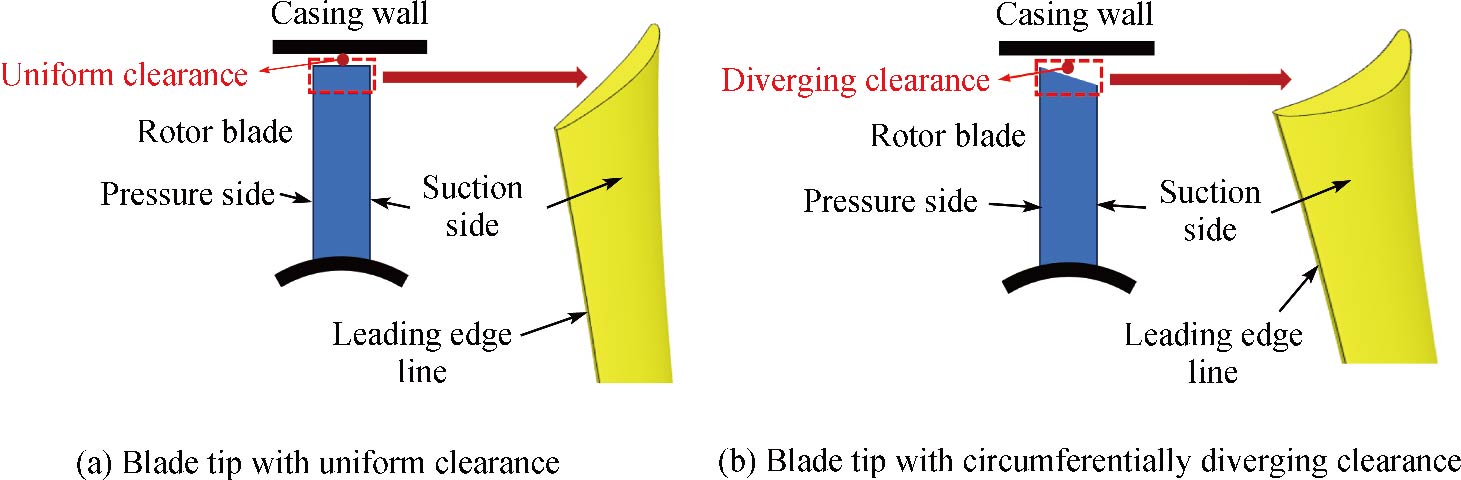
The presence of tip clearance not only ensures the structural safety of compression system in aero-engines, but also exerts significant negative impacts on internal flow stability due to the leakage flow. Previous studies by our team have shown that the induced shock resulting from the circumferentially diverging clearance structure has remarkable effect on suppressing leakage flow in transonic compressor rotors. Therefore, the inherent correlations between the characteristics of induced shock and leakage flow are further elucidated in this paper, and the influencing rules of induced shock wave on tip flow characteristic of transonic rotors are summarized as well. The results demonstrate that the enhancement of inhibitory effects on leakage flow and increase in the rotor’s stall margin can be achieved by both intensifying the induced shock wave and shifting its circumferential position away from the suction side edge of blade tip, which is possible by adjusting the circumferential expansion ratio of diverging clearance. The stall margin of the transonic rotor exhibits three distinct variations as the circumferential expansion ratio of the diverging clearance increases monotonically, and a maximum improvement of over 8.9% can be achieved through feature variations of the induced shock wave. The insufficient acceleration of the supersonic leakage jet flow over blade tip due to a smaller circumferential expansion ratio poses challenges in inducing a shock wave, resulting in an increased blockage effect and reduced stall margin of rotor. Meanwhile, excessive circumferential expansion ratio results in a pronounced adverse pressure gradient originating from the induced shock wave, leading to leakage flow separation at the blade tip and consequently weakening the intensity of induced shock waves while shifting its circumferential position towards the blade tip. As a result, further increasing the circumferential expansion ratio does not yield an enhanced rotor stall margin but instead exhibits a slight decreasing trend.

Cite this article

CUI Weiwei , ZHANG Long , ZHAO Qingjun , CHEN Xinyuan , CHANG Guozhang , WANG Cuiping . Influence Rules of Intensity and Circumferential Position of Induced Shock Wave on the Tip Flow Behaviors of a Transonic Rotor[J]. Journal of Thermal Science, 2025 , 34(5) : 1813 -1828 . DOI: 10.1007/s11630-025-2189-z

Outlines

/