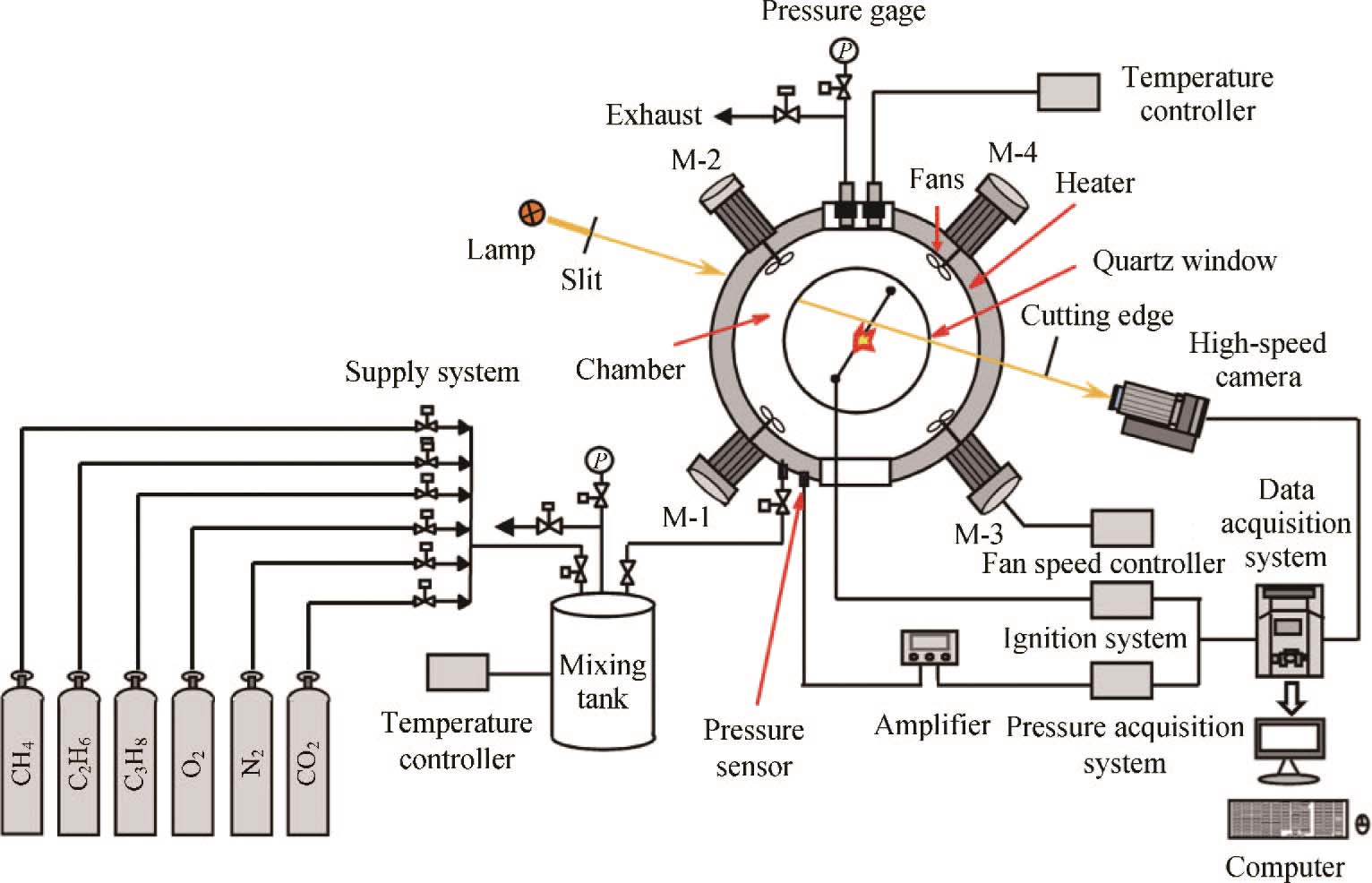
In this study, focusing on the geometry characteristics of spherical expanding flame, the turbulent premixed flames of natural gas/air mixtures were investigated in a fan-stirred turbulent combustor. The effects of initial temperature (T=300–400 K), initial pressure (P=0.1–0.3 MPa), turbulence intensity (u′=1.0–2.7 m/s), oxygen volumetric percentage (φ(O2)=15%–21%) and carbon dioxide volumetric percentage (φ(CO2)=0–20%) were delved into. The flame profile under the Cartesian coordinate system was derived from the schlieren images taken by the high-speed camera. Besides, from both macroscopic and microscopic perspectives, the influence of experimental conditions on the flame geometry characteristics was explored through flame front extraction, wavelet decomposition and network topology. The results demonstrate that for significant flame wrinkling, changes in species concentrations and turbulence intensity have more pronounced effects on the flame wrinkling ratio. The wrinkling of the flame front maintains a certain degree of similarity, as evidenced by the locally concentrated distribution of the angles of the maximum fluctuation radius. The disturbance energy under large-scale (D6–D8) disturbances exhibits relatively high values with a similar trend, exerting a significant impact on the geometry characteristics of the flame front. The peaks of correlation degree are scattered either with the decomposition scale or the development of flame radius, indicating no linear correlation between different detail components. Furthermore, the probability distribution of node degrees in key wrinkled regions exhibits different trends with that of large-scale wrinkling and disturbance energy, especially with changes in initial pressure. This occurs because the number of key wrinkles varies based on the perturbation’s strength or the region’s span. Consequently, an increase in the fluctuation frequency of the flame’s local radius may not necessarily lead to an increase in the number of key folded regions.
[1] Kleinebrahm M., Weinand J., Naber E., et al., Analysing municipal energy system transformations in line with national greenhouse gas reduction strategies. Applied Energy, 2023, 332: 120515.
[2] Turan M., Flamand T., Optimizing investment and transportation decisions for the European natural gas supply chain. Applied Energy, 2023, 337: 120859.
[3] Shu J., Fu J., Liu J., et al., Influences of excess air coefficient on combustion and emission performance of diesel pilot ignition natural gas engine by coupling computational fluid dynamics with reduced chemical kinetic model. Energy Conversion and Management, 2019, 187: 283–296.
[4] Renou B., Boukhalfa A., An experimental study of freely propagating premixed flames at various lewis numbers. Combustion Science and Technology, 2001, 162: 347–370.
[5] Ichikawa Y., Otawara Y., Kobayashi H., et al., Flame structure and radiation characteristics of CO/H2/CO2/air turbulent premixed flames at high pressure. Proceedings of the Combustion Institute, 2011, 33: 1543–1550.
[6] Peters N., The turbulent burning velocity for large-scale and small-scale turbulence. Journal of Fluid Mechanics. 1999, 384: 107–132.
[7] Zimont V., Gas premixed combustion at high turbulence. Turbulent flame closure combustion model. Experimental Thermal and fluid sicence, 2000, 21: 179–186.
[8] Veynante D., Vervisch L., Turbulent combustion modeling. Progress in Energy and Combustion Science, 2002, 28: 193–266.
[9] Wang Q., Zheng W., Li Z., et al., Three-dimensional numerical simulations on spherical expanding flame of premixed natural gas/air mixtures. Fuel, 2024, 365: 131185.
[10] Haq M., Sheppard C., Woolley R., et al., Wrinkling and curvature of laminar and turbulent premixed flames. Combustion and Flame, 2002, 131: 1–15.
[11] Jiang Y., Li G., Li H., et al., Experimental study on the turbulent premixed combustion characteristics of 70%H2/30%CO/air mixtures. International Journal of Hydrogen Energy, 2019, 44: 14012–14022.
[12] Chaudhuri S., Saha A., Law C., On flame-turbulence interaction in constant-pressure expanding flames. Proceedings of the Combustion Institute, 2015, 35: 1331–1339.
[13] Wang S., Elbaz A., Wang Z., et al., The effect of oxygen content on the turbulent flame speed of ammonia/oxygen/ nitrogen expanding flames under elevated pressures. Combustion and Flame, 2021, 232: 111521.
[14] Sun Z., Li G., Propagation speed of wrinkled premixed flames within stoichiometric hydrogen-air mixtures under standard temperature and pressure. Korean Journal of Chemical Engineering, 2017, 34: 1846–1857.
[15] Wang J., Zhang M., Huang Z., et al., Measurement of the instantaneous flame front structure of syngas turbulent premixed flames at high pressure. Combustion and Flame, 2013, 160: 2434–2441.
[16] Wang J., Nie Y., Zhang W., et al., Network topology of turbulent premixed Bunsen flame at elevated pressure and turbulence intensity. Aerospace Science and Technology, 2019, 94: 105361.
[17] Zheng W., Wang Q., Chen X., et al., Experimental study on turbulent burning velocities of premixed flames for natural gas/air mixtures. Experimental Thermal and Fluid Science, 2023, 150: 111047.
[18] Chen X., Zeng W., Zheng W., et al., Experimental and kinetic modeling study on the oxidation and laminar combustion characteristics of natural gas. Fuel, 2023, 344: 128019.
[19] Cai X., Wang J., Bian Z., et al., Self-similar propagation and turbulent burning velocity of CH4/H2/air expanding flames: Effect of Lewis number. Combustion and Flame, 2020, 212: 1–12.
[20] Brequigny P., Halter F., Mounaïm-Rousselle C., Lewis number and Markstein length effects on turbulent expanding flames in a spherical vessel. Experimental. Thermal and Fluid Science, 2016, 73: 33–41.
[21] Siano D., D’Agostino D., Knock detection in SI engines by using the discrete wavelet transform of the engine block vibrational signals. Energy Procedia, 2015, 81: 673–688.
[22] Nair A., Taira K., Network-theoretic approach to sparsified discrete vortex dynamics. Journal of Fluid Mechanics, 2015, 768: 549–571.
[23] Singh J., Vishwanath R., Chaudhuri S., et al., Network structure of turbulent premixed flames. Chaos, 2017, 27: 043107.
[24] Bradley D., Haq M., Hicks R., et al., Turbulent burning velocity, burned gas distribution, and associated flame surface definition. Combustion and Flame, 2003, 133: 415–430.
[25] Jiang Y., Li G., Li H., et al., Effect of flame inherent instabilities on the flame geometric structure characteristics based on wavelet transform. International. Journal of Hydrogen Energy, 2018, 43: 9022–9035.
[26] Damköhler G., Der Einfluss der Turbulenz auf die Flammengeschwindigkeit in Gasgemischen. Zeitschrift Für Elektrochemie Und Angewandte Physikalische Chemie, 1940, 46: 601–626.

