With the increasing of inlet temperature and pressure of the heavy-duty gas turbine, the flow conditions in the turbine become more complicated, and the aerodynamic loss inside the cascade also increases. This problem is particularly serious in small aspect ratio blades. How to reduce the aerodynamic loss inside the cascade channel becomes quite urgent now. Based on previous studies, it can be seen that the positively curved blade can reduce the secondary flow loss at the blade end, but it will increase the profile loss, while the negatively curved blade behaves just in the opposite way of the positively curved blade. Therefore, this paper proposes a positively curved blade with negatively curving at blade end, and this design can help to reduce the negative effect of the positive curving modification on the middle of the blade. In this paper, the last stage of the GE-E3 high-pressure turbine is taken as the research object, and the composite curving modification of the last stage stator cascade is carried out. The influence of the positive curving and the composite curving on the flow field is compared by numerical simulation. The results show that within the scope of this study, the reduction amplitude of total pressure loss coefficient of composite curved blade is about 1.10 times that of positive curved blade, and the increasing amplitude of total to static efficiency is about 1.16 times that of positive curved blade. The composite curving modification greatly improves the turbine performance. The research results provide guidance for the design of high-performance turbine blades.
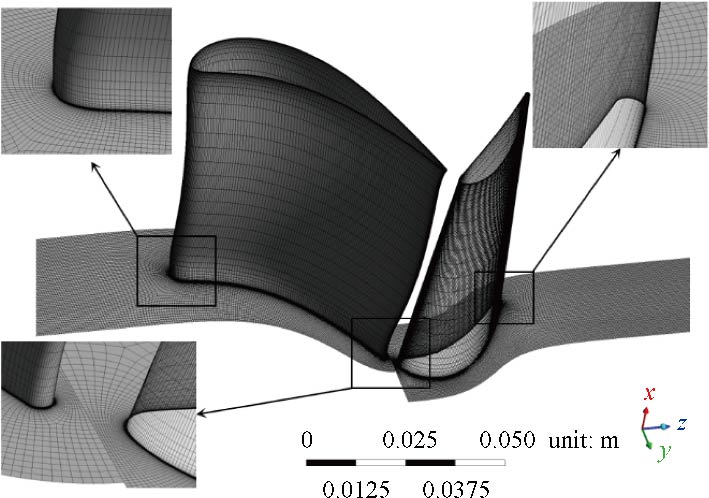
[1] Ainley D.G., Performance of axial-flow turbines. Proceedings of the Institution of Mechanical Engineers, 1948, 159(1): 230–244.
[2] Hawthorne W.R., Rotational flow through cascades Part I. The components of vorticity. Quarterly Journal of Mechanics and Applied Mathematics, 1955, 8(3): 266–279.
[3] Armstrong W.D., The secondary flow in a cascade of turbine blades. London: Aeronautical Research Council, 1955.
[4] Klein A., Untersuchungen über den einfluß der zuströmgrenzschicht auf die sekundärströmungen in den beschaufelungen von axialturbinen. Forschung im Ingenieurwesen A, 1966, 32(6): 175–188.
[5] Horlock J.H., Lakshminarayana B., Secondary flows: theory, experiment, and application in turbomachinery aerodynamics. Annual Review of Fluid Mechanics, 1973, 5(1): 247–280.
[6] Wang H.P., Olson S.J., Goldstein R.J., et al., Flow visualization in a linear turbine cascade of high performance turbine blades. Journal of Turbomachinery, 1997, 119(1): 1–8.
[7] Lakshminarayana B., Horlock J.H., Secondary flows and losses in cascades and axial-flow turbomachines. International Journal of Mechanical Sciences, 1963, 5(3): 287–307.
[8] Sieverding C.H., Recent progress in the understanding of basic aspects of secondary flows in turbine blade passages. Journal of Engineering for Gas Turbines and Power, 1985, 107(2): 248–257.
[9] Wang Z.Q., Feng G.T., Wang S.T., et al., Study on the secondary flow vortex structure in turbine blades. Journal of Engineering Thermophysics, 2002, 23(5): 553–556.
[10] Wu C.H., A general theory of three-dimensional flow in subsonic and supersonic turbomachines of axial, radial, and mixed-Flow types. Transactions of the American Society of Mechanical Engineers, 1952, 74(8): 1363–1380.
[11] Filippov G.A., Wang Z.Q., The calculation of axial symmetric flow in a turbine stage with small ratio of diameter to blade length. Journal of Moscow Power Institute, 1963, 47: 63–78.
[12] Wang Z.Q., Su J.X., New progress in the mechanism of reducing energy loss in curved and twisted blade cascades. Journal of Engineering Thermophysics, 1994, 15(2): 147–152.
[13] Yao H., Zhou X., Yu X.J., et al., Effect of curved blades on secondary water drop motion characteristics and water erosion. Journal of Power Engineering, 2017, 37(10): 808–813.
[14] Yao H., Zhou X., A pioneering method for reducing water droplet erosion. Journal of Fluids Engineering, 2018, 140(6): 061401.
[15] Chen B., Gao X.L., Yuan X., Three-dimensional aerodynamic optimization design of blades based on NURBS. Journal of Engineering Thermophysics, 2006, 27(5): 763–765.
[16] Arabnia M., Ghaly W., A strategy for multi-point shape optimization of turbine stages in three-dimensional flow. Turbo Expo: Power for Land, Sea, and Air. 2009, Paper No: GT2009-59708
[17] Tan C., Zhang H., Chen H., et al., Blade bowing effect on aerodynamic performance of a highly loaded turbine cascade. Journal of Propulsion and Power, 2010, 26(3): 604–608.
[18] Yao H., Zhou X., Wang Z.Q., Using a bowed blade to improve the supersonic flow performance in the nozzle of a supersonic industrial steam turbine. Journal of Engineering for Gas Turbines and Power, 2017, 139(10): 102604.
[19] An B.T., Han W.J., Wang Z.Q., Experimental study of the mechanism of energy loss reduction for curved blades. Journal of Engineering for Thermal Energy and Power, 2000, 15(5): 498–501.
[20] Wang S., Wang Z., Feng G., Numerical simulation of 3D flow field structure in turbine cascade with bowed blades. ASME Turbo Expo 2001: Power for Land, Sea, and Air, 2001, Paper No: 2001-GT-0442.
[21] Xue X.X., Research on secondary flow characteristics and control of subsonic high-load turbine cascade. Harbin Institute of Technology, 2021.
[22] Xue X., Wang S.T., Luo L., et al., The compound bowing design in a highly loaded linear cascade with large turning angle. Proceedings of the institution of mechanical engineers, Part G: Journal of Aerospace Engineering, 2020, 234(16): 2323–2336.
[23] Haller G., An objective definition of a vortex. Journal of Fluid Mechanics, 2005, 525: 1–26.
[24] Langtry R.B., Menter F.R., Likki S.R., et al., A correlation-based transition model using local variables-part II: Test cases and industrial applications. Journal of Turbomachinery, 2006, 128(3): 423–434.
[25] Timko L.P., Energy efficient engine high pressure turbine component test performance report. US: NASA, 1984: 5–15.
[26] Wang Z.Q., Zheng Y., Research status and development trend of curved and twisted blades of turbomachinery. China Engineering Science, 2000, 2(6): 40–48.
[27] Wang S.T., Xue X.X., Zhou X., Luo L., Qualitative analysis and application verification of composite bending of large angle turbine cascade. Journal of Aerodynamics, 2021, 36(7): 1345–1355.
[28] Luo L., Research on turbine aerodynamics and cooling technology of small flow turboshaft engine. Harbin: Harbin University of Technology, 2012.

